A Film Casino, Read Through Its Surfaces
Read film casino surfaces through tables, walls and floors to see how set materials shape character, status and enclosure without mistaking them for a real venue.
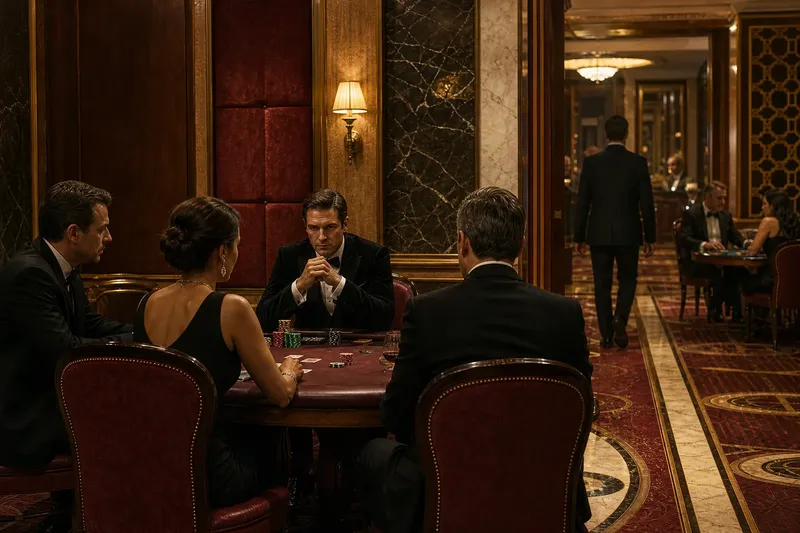
Film casino surfaces tell you how a scene wants its room to be read. A table, a wall panel or a strip of flooring can assign status and divide characters before anyone places a bet; none of them, on its own, records how an actual casino is built.
Read each finish as part of the set’s design, not as a certificate of authenticity. The useful question is what the material does to the scene’s social arrangement: who appears central, who seems contained, and who can leave.
Tables and status
The table gives a casino scene a place for people to gather, but its details can also sort those people. A broad, upholstered rail makes the table feel like a formal boundary. A plain, narrow edge leaves the arrangement less ceremonious.
Notice who gets the best position around it. A character placed at the head of a long table may seem to command the group, while someone shown at the edge can appear peripheral even when they are playing. The table’s shape and the camera’s framing work together; neither offers a reliable plan of the full room.
Condition adds another social cue. Worn fabric and softened edges can suggest an established setting or a game with history. An immaculate surface can make the scene feel newly arranged, exclusive or deliberately artificial. These are readings of the image, not evidence about the upkeep of a real venue.
Walls as boundaries
Walls show whether the scene treats the casino as a public room, a private enclosure or a theatrical backdrop. Timber panels and fabric coverings can make the space feel contained. Repeated sections of stone or painted panels can impose a more formal order.
Pay attention to where one material meets another. A border, metal strip or framed panel can separate a character from the surrounding group without placing them in a different room. The set may be using that boundary to mark rank, tension or exclusion.
Repeated wall bays can imply a larger interior than the camera reveals. That repetition resembles a row of identical book spines: it suggests a continuing order, but tells you little about what lies beyond the visible section. Film sets need only provide the space required for the shot, and a convincing background is not a floor plan.
A decorative panel behind a central character can work like a stage backdrop. If the scene gives that panel unusual prominence, read it as part of the character’s presentation rather than proof that the venue is consistently ornate.
Floors and movement
Flooring helps establish how freely people can move around the table. Carpet can make a scene feel socially contained, while stone or timber can make the route across the room more conspicuous. Look at where characters stand and whether the frame gives them visible room to pass one another.
Pattern can organise the composition. A border leading towards the table may draw the viewer into the gathering; a strong motif under a character can make that person seem set apart. If a pattern ends abruptly at the edge of a shot, the cut may simply exclude the rest of the floor.
Movement is more revealing than a general impression of spaciousness. A character who crosses an open stretch appears to have access to the room; one kept within a tight cluster seems more constrained. The scene may create that distinction through framing as much as through the set itself.
Materials and character
Look at how materials distinguish one part of the casino from another. Upholstered fabric, timber, stone and metal each bring different associations, but their meaning depends on placement. A metal trim around a private booth can mark it as separate; the same trim across a public wall may read as decoration.
Contrasts often carry more information than a single finish. A soft chair beside a hard table edge can make a character’s seat seem comfortable but controlled. A plain wall behind elaborate furniture can make the furniture appear more important. Ask what the contrast assigns to the people in the shot, rather than compiling a catalogue of surfaces.
Reflections can matter, but their clearest use here is spatial: a mirror may show a character’s relation to someone outside the direct frame, or make a partition seem less final. Do not treat a reflection as a dependable map. It may repeat only what the scene needs the viewer to see.
How do surfaces organise the scene?
What should I notice first?
Start with the table and identify who sits where. Then follow the visible boundaries made by walls, floor patterns and changes in material. This gives you a simple account of the room’s social arrangement.
Can materials reveal a character’s status?
They can suggest status through placement and contrast, but they cannot establish it alone. A character isolated by a formal booth may appear privileged or excluded; the scene’s dialogue and action help distinguish those readings.
Does a repeated wall pattern prove the room is large?
No. Repetition can make a limited set appear to continue beyond the frame. Treat it as a visual suggestion unless the film shows how the space connects.
What if the layout changes between shots?
Check whether the camera has moved to a different part of the set or whether the cut changes the apparent relation between furniture and walls. Note the change without forcing every shot into one consistent plan.
Notes for close viewing
Keep observation separate from interpretation. Record what the frame actually shows, then describe the social effect you think it creates. Use this list to decide what to look at next:
- Table position: Check who sits at the centre and who is placed at the edge; if one person is isolated, consider whether the scene presents them as powerful or excluded, then compare their position with the next shot.
- Table edge: Check whether the rail is broad and padded or narrow and plain; if it frames the players like a formal boundary, note that effect, otherwise describe the table as visually unobtrusive.
- Wall divisions: Check for borders, panels or material changes; if one character is set apart by a division, record the separation, otherwise treat the wall as a continuous background.
- Floor route: Check whether a character has visible space to cross the room; if the route is open, note their apparent access, otherwise describe how the frame confines movement.
- Material contrast: Check which finishes sit beside one another; if a contrast singles out a seat or character, identify that emphasis, otherwise avoid assigning status on the basis of material alone.
- Repeated details: Check whether wall panels or floor motifs continue across cuts; if they do, note how repetition suggests continuity, otherwise leave the room’s unseen extent unresolved.
- Reflected figures: Check whether a mirror or glass surface shows another person or part of the room; if it changes who seems connected, describe that relation, otherwise set it aside as a minor detail.
Imagine an invented scene with a long timber table, one padded chair at its head, plain chairs along the sides and a patterned wall divided by a dark border. First, note the chair at the head and the table’s length; next, observe that the border separates the seated group from the wall behind them; then check whether the camera gives the head chair a clear view of the others. The resulting reading is that the room presents its occupant as central and the group as ordered around them. If a later shot shows the same chair at the edge of the gathering, revise that reading towards a more unsettled hierarchy rather than claiming the set has a fixed architectural plan.
For film casino surfaces, the most useful question is not whether a room looks authentic, but how its materials arrange people and attention. A persuasive set can make that arrangement feel natural; keeping the visible evidence separate from the implied venue lets you see the craft without confusing the two.